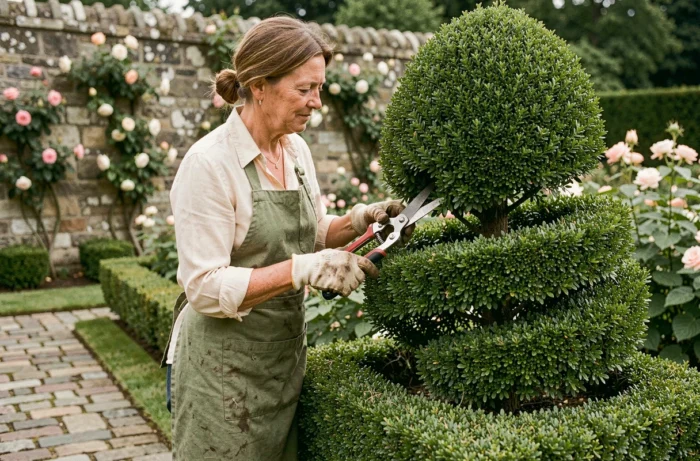
Plant sculpture, or topiary art, involves trimming a shrub or hedge into a geometric, figurative or abstract shape that the plant retains as long as regular maintenance keeps it defined. The technique relies on certain plants’ ability to produce new shoots after each cut, gradually thickening the foliage around a predetermined outline.
Toxicity, box tree moth and nesting: factors to consider before the first cut
Before choosing a plant and planning a trimming schedule, three factors deserve particular attention, as they determine whether the project is viable in the long term.
Boxwood is still the plant most commonly associated with topiary, thanks to its dense foliage and slow growth. However, it can be affected by box tree moth and dieback. If your garden already has boxwood, check its health before starting a sculpting project to avoid spending months working on a weakened plant.
Yew, another topiary classic, regenerates quickly and has very fine-textured foliage, making it ideal for detail work. All parts of the yew are toxic, which is an important consideration if children or pets use the garden. Alternatives such as privet or viburnum tinus can be sculpted into similar shapes without this risk.
As for timing, the OFB recommends avoiding trimming during the bird nesting season. For private individuals, this is not a general nationwide ban on trimming all private hedges, but destroying the nests or eggs of protected species is indeed prohibited.
Even outside the most sensitive periods, you should still give the hedge a quick visual inspection before each trimming session: some species nest earlier or later depending on local conditions. Guides such as those available on sculpte-haie.com provide a concise reminder of these precautions.

Choose a shape that suits the plant’s growth
The shape you choose depends directly on the plant’s natural growth habit and rate of growth. Forcing a plant into a shape that differs too much from its natural form means more frequent trimming and can weaken its structure.
Simple geometric shapes: cube, cone, sphere
Shrubs with steady growth and dense branching (boxwood, yew, holly) are well suited to geometric shapes. The sphere is the easiest shape for beginners, as it allows for slight irregularities in the cut. A cone works well for naturally conical plants, such as some yews and cypresses.
Waves and cloud pruning
Cloud pruning follows the existing foliage masses rather than forcing them into a rigid shape. The technique involves exposing the main branches to create rounded foliage pads separated by open spaces. It works particularly well on shrubs with tiered growth or older hedges whose woody structure is already established.
A privet or hornbeam hedge, often considered ordinary, can be transformed into a series of waves by trimming its upper section into an undulating shape. The result adds visual movement without requiring the millimetre-perfect precision of a figurative design.
Step-by-step hedge sculpting technique
Plant sculpting takes place over several growing seasons. Trying to achieve the final shape in a single session weakens the plant and leaves gaps in the foliage.
- First season: trim the hedge, reducing its overall volume to encourage branching. The aim is to create denser foliage, not to shape it yet.
- Second season: set up a guide (wire, a metal frame or a simple stake) and begin outlining the shape by cutting away anything that extends beyond it.
- Following seasons: refine the outline with each trim. Two to three trims a year are enough for most moderately growing plants, with more needed for vigorous plants such as privet or hornbeam.
For complex shapes (spirals, animals), a galvanized wire mesh frame placed inside the foliage serves as a permanent guide. The plant grows through the mesh, and each trim removes whatever extends beyond the frame.
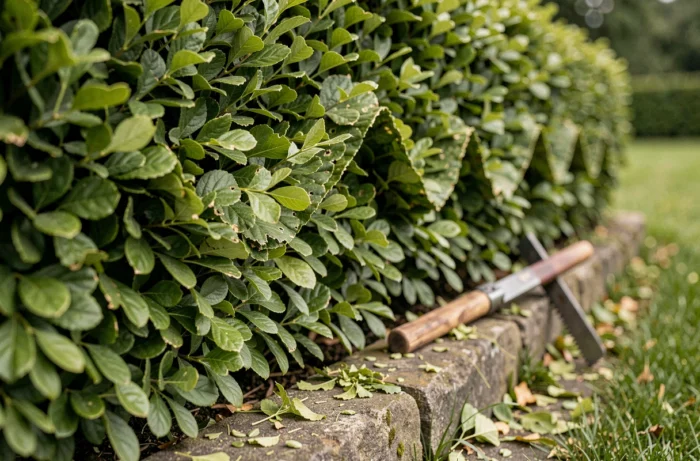
Plant-sculpting tools: hedge trimmer, shears and secateurs
Your choice of tool determines how fine the finish will be. Three types of tools cover almost every need.
- The topiary trimmer (or finishing hedge trimmer): lightweight, easy to handle and fitted with a short blade. It is used to smooth flat surfaces and keep the edges crisp on shapes that have already been formed. Its compact size makes it suitable for tight curves.
- Hand shears: essential for precise touch-ups and small plants. They give you complete control over every cut, reducing the risk of removing too much material.
- Secateurs: used to cut individual branches within the shape, remove dead wood and create open spaces in cloud pruning.
A sharp tool makes a clean cut that heals quickly. A blunt blade crushes and tears the wood, leaving it vulnerable to fungal diseases.
Long-term care for garden topiary
Precisely shaped topiary requires regular attention. Without ongoing care, the shrub gradually returns to its natural growth habit, and its outline blurs over one or two growing seasons.
Choose a shape that fits the time you can realistically devote to it. A simple sphere needs trimming twice a year. A spiral or figurative shape may need four or five trims. A modest shape that is well maintained is better than an ambitious sculpture that deteriorates for lack of time.
Fertilizing after each trim with an organic amendment at the base of the hedge helps the plant quickly replace the foliage that has been removed. Mulch helps retain soil moisture and suppress weeds, directly benefiting foliage density—the raw material for any plant sculpture.
The final thing to keep in mind is patience. Topiary reaches its full density after several years of successive trimming. It becomes more defined with each season, provided you respect the plant’s growth cycle rather than forcing the schedule.