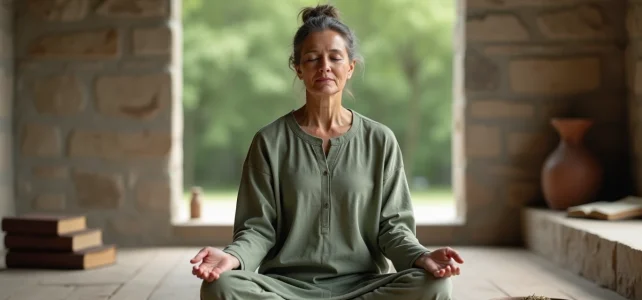
Spirituality refers to a personal relationship with what transcends material experience: the quest for meaning, connection to the sacred, questioning of death or transcendence. Today, this term encompasses very different realities depending on whether it is situated within an established religious tradition or in an individual approach detached from any institution. Understanding these distinctions allows us to grasp the debates that traverse contemporary philosophy, sociology, and theology.
Secularization and Recomposition of the Believable in France
Secularization does not mean the end of the religious. It refers to the process by which religious institutions lose their grip on social, legal, and political organization. In France, this movement has accelerated over several decades, with a steady decline in worship practices.
The 2022 report from the European Values Study confirms a precise trend: the proportion of individuals identifying as non-religious is increasing, but adherence to spiritual beliefs (energy, destiny, invisible forces) does not decrease at the same rate. Belief does not disappear; it shifts.
This phenomenon has a name in the sociology of religion: the recomposition of the believable. People are leaving a unified dogmatic framework to assemble their own references, drawing from various traditions. The question of God, faith, and truth remains, but the answers circulate outside historical channels. Journals and online spaces for reflection, like those found on revuedeliberee.org, contribute to this renewal of intellectual debates surrounding these changes.

Spirituality Without Religion: What the Expression Means for Young Adults
The expression “spiritual but not religious” has become common vocabulary, particularly among 18-35 year-olds in Western Europe. It reflects a rejection of institutional mediations (clergy, liturgy, dogma) combined with a continuation of inner searching.
Concretely, this stance manifests through practices borrowed from several traditions:
- Buddhist-inspired meditation, often dissociated from its original doctrinal framework and reduced to a technique for stress management or personal development
- Reference to concepts from Hinduism (chakras, karma) reinterpreted without reference to foundational texts or transmission lineages
- Interest in Western esoteric currents (astrology, tarot, lithotherapy) presented as tools for self-exploration rather than as belief systems
This à la carte spirituality poses a real philosophical problem. It tends to reduce spiritual experience to individual benefit (well-being, self-fulfillment), disregarding the communal dimension and ethical demands that great religious traditions carry.
Digital Spirituality: Screens, Algorithms, and Inner Life
Since the Covid-19 pandemic, the spread of meditation, prayer, or spiritual guidance applications (Headspace, Calm, Hallow) has significantly accelerated. Communities are forming on Instagram, TikTok, or Discord around contemplative practices, readings of sacred texts, or neo-pagan rituals.
The digital realm is becoming a space for spiritual socialization for individuals with no ties to a parish or temple. A 2023 report from the Pew Research Center on religion and digital life documents this trend: the consumption of spiritual content online has significantly increased.
This evolution raises questions that the philosophy of religion is beginning to address. Does spiritual experience mediated by an algorithm remain an authentic experience of the spirit? Does content personalization risk trapping each individual in a bubble of self-confirming beliefs, contrary to the confrontation with otherness that most traditions imply?
Limits of Technological Mediation
Guided meditation through an app operates on a consumer-product model. The user selects a duration, a theme, a level of difficulty. This logic of personalization comes into tension with what contemplative traditions (Christian monasticism, Zen, Sufism) describe as a relinquishment of one’s own will.
Man does not program his inner transformation according to these traditions. He prepares for it, often in a collective framework and under the guidance of a master whose authority does not rely on a recommendation algorithm.

Interreligious Dialogue and Pluralism: Rethinking Truth in a Plural Context
Religious pluralism is not a new phenomenon, but its visibility in European societies is. The coexistence of Islam, Christianity, Judaism, Buddhism, and non-affiliated currents in the same political space compels us to rethink the notion of religious truth.
Three philosophical positions structure this debate:
- Exclusivism asserts that only one tradition holds the truth about God and salvation. Others are in error or approximation.
- Inclusivism recognizes elements of truth in other religions but organizes them around a tradition considered as plenary.
- Theological pluralism asserts that multiple religious paths legitimately lead to the divine, without hierarchy among them.
None of these positions achieves consensus. Exclusivism struggles to justify the rejection of millennia-old traditions. Theological pluralism risks dissolving doctrinal specificities in favor of vague syncretism. The debate remains open, and it is precisely this unresolved tension that fuels research in philosophy of religion today.
Contemporary spirituality is characterized by this unprecedented cohabitation between ancient traditions, individualized practices, and technological mediations. The inherited categories (religious/secular, sacred/secular, faith/science) are no longer sufficient to describe this landscape. Thought on existence, spirit, and meaning continues to evolve, driven by questions that precede institutions and will outlast them.