
Nursing education in France is based on a three-year curriculum at the Institute of Nursing Training (IFSI), culminating in the State Diploma of Nursing (DEI). Two admission pathways have coexisted since the 2019 reform: selection based on application via Parcoursup for high school graduates, and a competitive exam reserved for candidates in continuing professional training.
Actual cost of three years of nursing studies depending on status and region
Guides rarely go beyond the mention of “free training in the public sector.” The budgetary reality for a student in IFSI varies significantly depending on their status (initial training, continuing education, apprenticeship) and the geographical location of the institute.
In initial training, public IFSIs charge university registration fees. Private IFSIs apply significantly higher tuition fees, sometimes several thousand euros per year. For candidates in continuing professional training (FPC), the annual fee can far exceed that of initial training, with financial arrangements involving the employer, an OPCO, or Pôle emploi.
We observe that some IFSIs now detail the internship and transport allowances paid during training, which reduces the actual out-of-pocket expenses. These allowances vary from one institution to another and from one region to another. A student in Île-de-France does not incur the same housing costs as a student in Brittany, and this expense often weighs more heavily than tuition fees themselves.
To understand the steps to become a nurse in their financial dimension, one must add up registration fees, materials (uniform, stethoscope, textbooks), transport to internship locations, and the local cost of living. The total over three years can differ from one to three times depending on the configurations.

Admission to IFSI via Parcoursup: selection criteria for the application
The Parcoursup pathway does not include written or oral exams for high school graduates. The assessment is based on the academic record, extracurricular activities, the motivation letter (motivated training project), and, in some IFSIs, a specific weighting of scientific grades.
The formal prerequisites remain simple: hold a baccalaureate (or a recognized equivalent) and be at least 17 years old by December 31 of the year of entry into training. Selection hinges on the quality of the application.
What the examination committees concretely evaluate
- The coherence between the academic path and the professional project, evidenced by experiences in the health or social sector (volunteering, discovery internships, civic service)
- Results in subjects related to the expected competencies: biology, French, human sciences, and the consistency of grades over the last two years
- The ability to express oneself in writing in the motivated training project, which must demonstrate a realistic understanding of the profession and not just a declared vocation
We recommend that candidates check the expectations published by each IFSI on the Parcoursup sheet, as the weighting of criteria varies from one institute to another.
FPC pathway and professional retraining: a distinct admission process
Candidates in continuing professional training go through a separate process that retains selection tests. This system applies to individuals who can justify at least three years of contributions to a social protection scheme by the date of registration for the tests.
The FPC competition generally includes a application file followed by an interview before a jury. The exact nature of the tests may differ depending on the IFSIs. Candidates in retraining should anticipate a delay in securing funding (CPF, Transitions Pro, employer) that adds to the selection timeline.
A candidate accepted into IFSI through FPC follows exactly the same training as students from Parcoursup. The courses, internships, and evaluations are identical. The difference lies in the funding and status during training (employee on training leave, unemployed with benefits, etc.).
Structure of the three years in IFSI: alternating theory and clinical internships
The training is organized into six semesters combining theoretical teachings at the institute and clinical internships in hospital or non-hospital settings. Validation is based on competencies and European credits (ECTS), facilitating potential further studies or international mobility.
Distribution between courses and internships
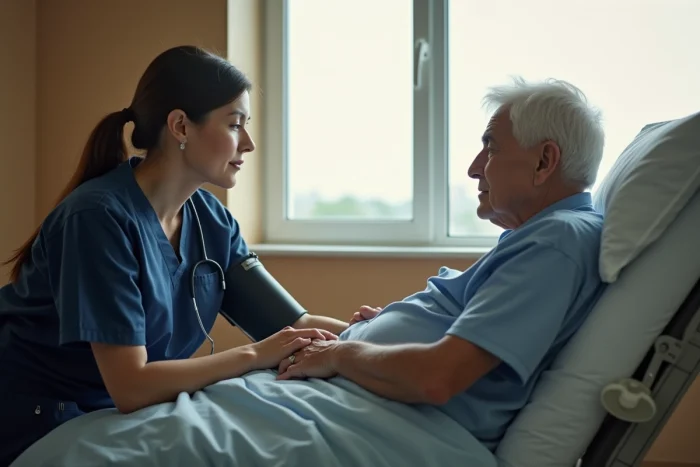
The volume of internships represents about half of the training time over the three years. Students rotate through different departments (medicine, surgery, psychiatry, home care, pediatrics) to acquire clinical versatility.
The theoretical teachings cover biological and medical sciences, human sciences, health law, and care techniques. The workload is intensive, and the main difficulty lies in the articulation between periods of intensive courses and full-time internships, sometimes far from home.
Validation and obtaining the DEI
Each semester includes written and practical evaluations, as well as validation of internship competencies by tutors. The DEI is awarded after validation of the 180 ECTS credits and confers the degree of license.
Once the diploma is obtained, registration with the National Order of Nurses is mandatory to practice. This administrative step, often unknown to young graduates, conditions the authorization to practice on French territory. The choice between salaried practice (hospital, clinic, nursing home) and liberal practice then arises, each involving distinct regulatory and financial constraints.