
A domestic blast freezer lowers the temperature of food much faster than a conventional freezer. While a freezer cools gradually over several hours, a blast freezer reaches very low temperatures in just a few tens of minutes. This rapid cooling reduces the size of ice crystals that form in the cells of the food, which better preserves their texture and nutritional qualities after thawing.
Before choosing a domestic blast freezer, it is important to understand that this appliance does not replace a storage freezer. The blast freezer is used to quickly lower the temperature, after which the food is transferred to a freezer for long-term storage. The two appliances work in complementarity, not in substitution.
Read also : Tips and Inspirations to Transform Your Home into a True Cocoon
Rapid freezing and crystal formation: the mechanism to understand
The physical principle behind blast freezing relies on the speed of passing through the maximum crystallization zone, located between approximately 0 and -5 °C. The longer food stays in this temperature range, the larger the ice crystals grow. Large crystals puncture cell walls, leading to a loss of juice and texture upon thawing.
A blast freezer passes through this critical zone in just a few minutes, compared to several hours for a static freezer. The micro-crystals that form do not damage the structure of the food. This is why properly frozen fish retains a firm flesh, while simply frozen fish can become mushy.
Read also : How to Choose the Ideal Household Alcohol for Effectively Disinfecting Your Home
For domestic use, this difference is especially significant for delicate foods: berries, fish fillets, fresh herbs, homemade dishes. For blanched vegetables or bread, the difference is noticeable but less pronounced.
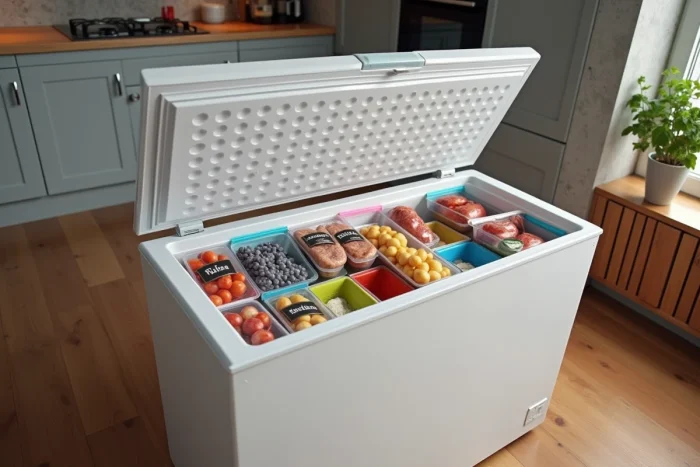
Refrigerant gas and F-Gas regulation: an underestimated purchasing criterion
Most buying guides discuss volume, format, and energy class. The refrigerant fluid used by the appliance is rarely mentioned, even though it determines the useful lifespan of the blast freezer and the ease of future repairs.
The European F-Gas regulation 2024/573 provides for a strong progressive reduction of HFCs by 2036. Manufacturers are turning to refrigerants with low global warming potential, primarily R600a (isobutane) and R290 (propane). A blast freezer purchased today with an HFC gas may pose supply issues for the fluid if a repair of the refrigeration circuit is necessary in a few years.
When purchasing, check the technical sheet or the appliance’s nameplate. A model operating on R600a or R290 limits the risk of regulatory obsolescence and facilitates technician intervention. This criterion weighs as much as the energy class in a sustainable purchasing logic.
Energy label for freezers and blast freezers: reading the new scale
Since March 2021, the European energy label classifies domestic cooling appliances from A to G. The old classes A+, A++, and A+++ have disappeared. An appliance rated C or D on the new scale often corresponds to an old A++ or A+++.
This overhaul changes the reading of product sheets. A blast freezer rated D is not a bad appliance. It can consume significantly less than an old freezer rated A+ according to the previous scale. The annual consumption in kWh, indicated on the label, remains the most reliable figure for comparing two models.
Some guidelines to help with the choice:
- Always compare the annual consumption in kWh rather than just the letter, as two appliances of the same class can vary significantly based on their volume and cooling technology
- A blast freezer operates in short and intense cycles (during the freezing phase), then often remains off or in standby between uses, which reduces its actual consumption compared to a freezer that is constantly plugged in
- The climate class (SN, N, ST, T) indicates the ambient temperature range in which the appliance operates optimally. A blast freezer installed in an unheated garage in winter or overheated in summer will consume more if it is not suited to these conditions

Usable volume and interior organization of a domestic blast freezer
The volume of a domestic blast freezer is generally smaller than that of a chest or upright freezer because its primary function is to freeze, not to store. The capacity is measured in liters, but it is the freezing capacity in kilograms per 24 hours that indicates the actual performance of the appliance.
An efficient blast freezer for a household of four should be able to handle several kilograms of food in a single session. If you prepare meals using batch cooking or freeze garden harvests, this figure takes precedence over gross volume.
Drawers, grids, and air circulation
The interior layout directly influences the efficiency of freezing. Foods should be arranged in a thin layer so that the cold can pass through them quickly. A blast freezer equipped with grids or perforated drawers promotes air circulation around the food, unlike full bins that create thermal stagnation zones.
Avoid overloading the blast freezer during a freezing session. Too much food at once slows the temperature drop and recreates the conditions of slow freezing, negating the very purpose of the appliance.
Connected freezers: gadget or real utility for domestic freezing
Recent ranges from several manufacturers incorporate connected functions: open door alerts, temperature rise notifications, real-time energy consumption tracking. Some models even offer an inventory of stored foods.
For a blast freezer, the temperature alert is of concrete interest. A poorly closed door or an unnoticed malfunction can compromise an entire batch of food being frozen. Receiving a notification in case of an abnormal temperature rise protects the food and prevents waste.
Consumption tracking helps identify an appliance that is starting to wear out or a faulty defrost cycle. Other functions (inventory, recipe suggestions) are more about convenience than food preservation.
The choice of a domestic blast freezer ultimately hinges on three precise technical axes: the speed of temperature drop, the type of refrigerant used, and the freezing capacity in kilograms. Storage volume and energy class matter, but they do not distinguish a blast freezer from a simple freezer. It is the rapid cooling performance that justifies the investment.