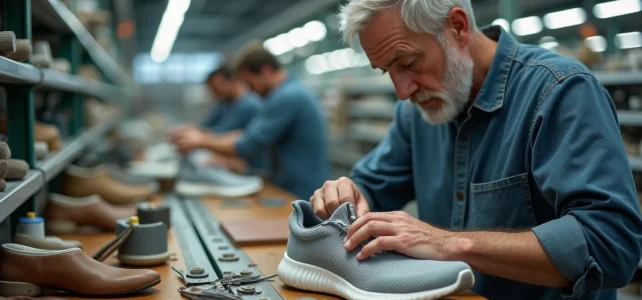
Skechers does not own any factories. The entirety of production relies on a network of subcontractors, primarily located in Asia, managed from the headquarters in Manhattan Beach, California. This asset-light model, adopted from the foundation by Robert Greenberg in 1992, influences every industrial decision of the brand, from material selection to the pace of collection renewal.
Skechers OEM Network and Geographic Diversification of Suppliers
The Skechers supply chain goes beyond the China-Vietnam duo that most analyses mention. Chinese OEM/ODM manufacturers, such as Bebenelle, openly claim to supply shoes distributed in European and North American markets. This multiplication of industrial partners responds to a logic of reducing supplier risk and capacity flexibility.
Related reading : Discover the age and origin of Pola Petrenko, a trendy actress and model
We observe that the multi-sourcing approach allows Skechers to adjust volumes by geographic area based on pricing or logistical constraints. A model intended for the European market can be assembled in a different factory than one targeting North America, even if the product reference is identical.
To delve into the origin and manufacturing of Skechers shoes, one must look beyond “Made in” labels and consider the contractual structure that binds the brand to its subcontractors.
See also : Rediscover the Timeless World of Little House on the Prairie and Its Secrets
- OEM suppliers produce according to strict specifications provided by the California design office, with no latitude on materials or assembly processes.
- Quality control is conducted remotely via PLM (Product Lifecycle Management) systems that trace each step, from cutting the upper to packaging.
- The distribution between Chinese, Vietnamese, and other Asian sites evolves from season to season based on available capacities and transportation costs.
Skechers CEE Kft: Centralized European Compliance in Budapest
Skechers has created a dedicated entity in Budapest, Skechers CEE Kft, designated as a responsible economic operator in the European Union. This structure, located at Revesz Street 27, 1138 Budapest, centralizes product responsibility for the entire European market: regulatory compliance, material safety, traceability.
This organizational choice deserves attention. Rather than entrusting compliance to each national subsidiary, Skechers concentrates management in a single entity. The result: an identified regulatory contact for market surveillance authorities, and harmonization of control procedures across all products sold in Europe.
This centralization also facilitates the management of product recalls or composition adjustments. A single decision point accelerates responsiveness to regulatory changes, particularly those related to the REACH regulation on chemical substances or textile labeling requirements.
Skechers Vegan Ranges: A Material Shift at the Core of the Collection
Since 2022-2023, Skechers has showcased ranges explicitly labeled “100% vegan” on mass-market models, not just on limited capsules. The Glide Step Pro Slip-Ins or the Go Walk Arch Fit 2.0 are marketed with the mention “made with 100% vegan materials.”
The shift to vegan touches the core collection, not the margin. This is a strong industrial signal: the production lines of subcontractors must ensure the complete absence of animal-derived materials, which involves specific material audits and separation of flows in the workshops.
In practice, this means that glues, dyes, and structural reinforcements must all meet vegan criteria. For an OEM manufacturer accustomed to handling leathers and animal glues on other lines, the coexistence of both flows in the same factory requires non-contamination protocols comparable to those in the food industry.

PLM Management and Remote Quality Control at Skechers
The asset-light model necessitates a centralized management tool. Skechers uses PLM platforms to manage the entire product cycle. Each model, from the initial sketch to the industrial approval, passes through a unique digital reference accessible simultaneously by California teams and partner factories.
This system allows for locking in technical specifications before production launch. Any change in material or process must be digitally validated before physical execution. Quality control reports (dimensional measurements, flex tests, abrasion resistance) are sent in real-time to Manhattan Beach.
Limits of Remote Control
Digital management does not replace physical audits. Skechers, like any brand with outsourced sourcing, remains dependent on the reliability of data transmitted by its suppliers. Discrepancies between reported test results and actual field conditions constitute a structural risk of the asset-light model.
The increasing demands for traceability in Europe (notably through Skechers CEE Kft) push the brand to strengthen its audit protocols. We recommend industry professionals monitor the evolution of due diligence obligations applicable to shoe importers in the EU, as these regulations redefine responsibilities throughout the supply chain.
The Skechers model illustrates a fundamental trend in the footwear industry: the brand designs, specifies, and controls, but does not manufacture. The added value lies in design, marketing, and logistical management, while the assembly expertise remains in the hands of Asian partners. This division of roles, economically efficient, places the quality of the supplier network at the center of product credibility.