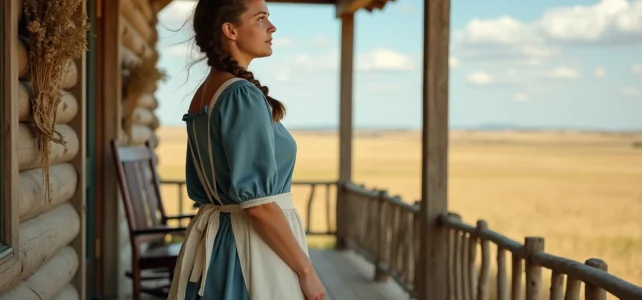
The original series from 1974 was filmed almost entirely in California, under a Mediterranean sun, while the Ingalls were supposed to be facing the winters of Minnesota. This geographical discrepancy, rarely questioned at the time, neatly summarizes the particular relationship that the production had with historical reality. This same ambiguity can be found in the treatment of Indigenous peoples, the living conditions of settlers, and the role of women on the American frontier.
Filming in California and the creation of a fictional Minnesota
When watching the episodes with a contemporary eye, the lighting reveals everything. The golden hills, the sparse vegetation, the visible heat on the actors’ faces bear no resemblance to the continental climate of the Great Plains. The technical team compensated with props (artificial snow, wind created by machines), but the result remained approximate.
You may also like : Diving into the origin and manufacturing of Skechers shoes: secrets and expertise
This choice was primarily economic and logistical. Filming in Simi Valley, near Los Angeles, allowed for team sharing, reduced travel, and controlled weather conditions. For viewers in the 1970s, the deception passed without difficulty. Today, we realize how much the setting conditioned the perception of pioneer life, making it seem softer and brighter than it actually was.
If the world of Little House on the Prairie continues to fascinate, it is also because this idealized version of the American frontier met a need for television comfort unique to its time.
Further reading : Discover the age and background of gom4rt, the rising streamer on Twitch
Netflix reboot and historical omissions of the original series
The reboot announced by Netflix for the summer of 2026 arrives in a very different context. The platform is part of a wave of reinterpretations of family classics from the 1970s-1980s, adapted this time for a younger audience more aware of representation issues. According to Variety, this trend of reboots of family dramas has significantly accelerated since 2024.
The central question for this new version concerns the treatment of Indigenous peoples. In the original series, Native Americans appeared sporadically, often reduced to threatening figures or secondary characters lacking depth. The novels of Laura Ingalls Wilder themselves contained problematic passages, which have since been acknowledged by American literary institutions.
New obligations for consulting tribes
At the end of 2025, new SAG-AFTRA guidelines made consultations with local tribes mandatory for any production featuring pioneer narratives. In practical terms, this means that the writers of the reboot must submit their scripts to Indigenous consultants before approval. This is a far cry from the original production’s approach, where narrative decisions were made without any external consultation.
The reboot also incorporates increased ethnic diversity in its casting, according to The Wrap. This approach reflects a normalization of inclusive casting in historical dramas in recent years. Reactions vary on this point, between purists attached to the 1974 version and viewers who expect a more honest reinterpretation of the period.
Working conditions for child actors, then and now
Alison Arngrim, who played Nellie Oleson, has regularly testified about the difficult conditions faced by young actors on the original set. The work schedules were intense, and protection protocols were almost non-existent compared to current standards.
- Physically demanding scenes (falls, fights, scenes in cold water) were filmed without stunt doubles or specific supervision for minors
- Karen Grassle, who portrayed Caroline Ingalls, publicly denounced humiliating behavior from Michael Landon on set
- Shooting hours frequently exceeded what would be allowed today for actors under sixteen
In a May 2026 interview with the Daily Mail, Arngrim emphasized that the strengthened anti-harassment protocols on modern sets radically change the experience for young actors. She sees this as a direct improvement linked to the movements for speaking out in the industry.
Laura Ingalls Wilder’s novels and discrepancies with the television series
The series and the books are often confused, even though they tell significantly different stories. The autobiographical novels of Laura Ingalls Wilder, published between 1932 and 1943, describe a life of deprivation, forced relocations, and mourning. The television series retained the setting and main characters, but the writers invented the majority of the plots starting from the second season.
The adaptation rights were only negotiated after the launch of the television project, which is unusual in the industry. This inversion of the usual process partly explains the liberties taken with the source material.
What the books tell that the series omitted
- The real food insecurity of settler families, with winters where famine was a direct threat
- Tensions with Indigenous populations, described ambiguously in the novels but almost absent from the series
- The deaths of several Ingalls children, treated with modesty in the books but largely sanitized on screen
- The central economic role of women in daily survival, reduced in the series to a classic domestic function
The book remains a primary source document on life in the Great Plains at the end of the 19th century. The series, on the other hand, created a Walnut Grove village closer to a moral tale than to a historical narrative.
The Netflix reboot will face this dual challenge: to satisfy the nostalgia of an audience attached to the television version while correcting blind spots that have become visible. The way the production addresses Indigenous peoples and the real conditions of pioneer life will measure the ambition of the project.