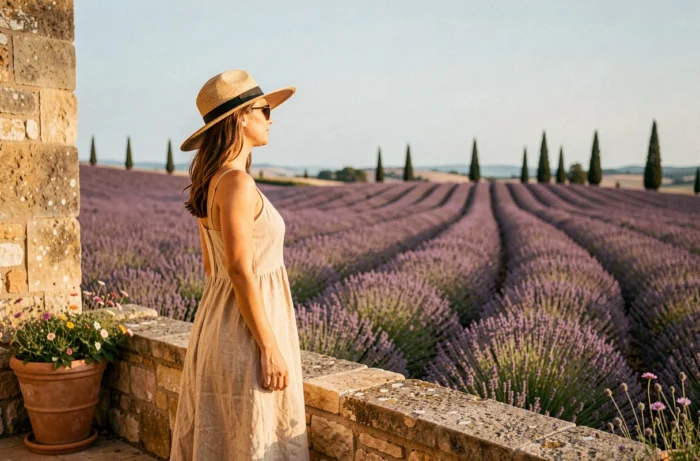
France welcomes each year a volume of visitors that places it among the top global destinations. This massive attendance is concentrated on a handful of sites, while the territory offers a diversity of landscapes, reliefs, and coastlines rarely matched within a single country. Choosing a vacation destination in France is therefore less about finding a beautiful place than identifying one that corresponds to an acceptable season, pace, and level of attendance.
Overtourism and quotas: what changes concretely for vacations in France
Several French natural sites now implement regulation measures: mandatory reservations, daily quotas, or regulation of seasonal rentals. A report from France 3 published on October 10, 2026, details how these measures modify access to certain highly sought-after destinations, particularly in the south.
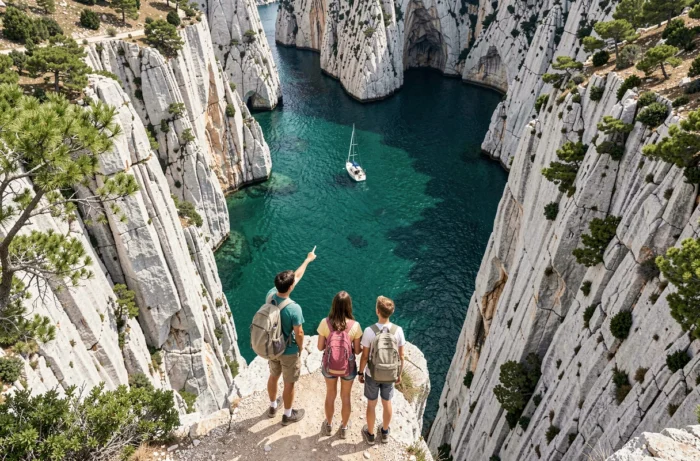
This trend has a direct consequence on planning. Booking an Airbnb accommodation or a parking space is no longer sufficient: it is necessary to check if the site itself imposes a time slot or a limited number of visitors per day. The Verdon Gorge, certain calanques, or portions of the Basque coastline are affected.
To identify destinations that combine attractiveness and real accessibility, cross-referencing multiple sources of information remains the most reliable method. The sheets available on touriste.fr allow for a quick assessment of access conditions and the seasonality of a place before booking.
The reflex to adopt: favor alternatives close to saturated sites rather than the sites themselves. A mountain lake near a famous spot often offers comparable landscapes with a fraction of the attendance.
Mountain destinations in summer: a trend confirmed by the figures
The mountains are no longer reserved for winter sports. An analysis published on October 1, 2026, based on data from Domaines Skiables de France, shows a marked increase in summer attendance in the French mountain ranges. The Pyrenees have seen a particularly noticeable rise.
Episodes of extreme heat partly explain this shift. When temperatures consistently exceed comfort thresholds in the plains or on the Mediterranean coast, altitude offers a significant thermal difference without having to leave the territory.
Pyrenees and Alps: two distinct profiles
The Alps have a well-established network of summer activities (hiking, mountain biking, via ferrata, nature parks). The accommodation options are dense, making organization easier for families.
The Pyrenees, less equipped with heavy tourist infrastructure, attract an audience seeking preserved nature. Attendance remains more moderate there, making it a relevant option for those who want to avoid crowds while accessing lake and high valley landscapes.
- Alps: wide choice of organized activities, numerous accommodations, but high attendance in July-August in well-known resorts
- Pyrenees: wilder setting, increasing attendance but still contained, sometimes longer road access
- Central massif (Auvergne, Aubrac): volcanoes, plateaus, thermal water, low tourist density, ideal for a peaceful trip

Atlantic coast and Brittany: regions suited for off-season vacations
French vacations extend beyond the peak of summer. This shift benefits regions like Brittany or the Atlantic coast, where the shoulder seasons offer pleasant weather conditions and reduced tourist pressure.
Brittany concentrates a dense coastal heritage: cliffs, islands accessible by boat, coastal hiking trails (GR34). The beaches are less crowded than in the Mediterranean, even in August. Finistère and Côtes-d’Armor remain among the least saturated destinations on the French coast for their level of scenic quality.
Atlantic coast: from the Basque Country to Vendée
The Basque Country combines sea, mountains, and gastronomy within a small area, but its growing popularity leads to land pressure and high accommodation prices in peak season. The Landes, just to the north, offer a comparable coastline (ocean, pine forest, lakes) with more accessible rates.
Vendée and Charente-Maritime attract family audiences thanks to supervised sandy beaches, water activities, and above-average sunshine compared to the Atlantic. These two departments regularly rank among the most sought-after family destinations for vacations in France.
Overseas: French destinations with contrasting trajectories
Overseas territories do not form a homogeneous block. An analysis published on September 22, 2026, shows that Saint-Martin and Saint-Barthélemy experienced a strong increase in their tourist traffic in 2025, while New Caledonia remained penalized by the events of 2024.
Before booking a trip to the overseas territories, checking local conditions (air transport, social context, cyclone season) is a step not to be overlooked. Guadeloupe and Martinique remain the most accessible islands in terms of connections from the mainland, with accommodation options ranging from rural gîtes to resorts.
- Saint-Martin, Saint-Barthélemy: strong increase in tourist dynamics, high-end positioning
- Guadeloupe, Martinique: air accessibility, nature diversity and beaches, developed family offerings
- La Réunion: nature and hiking destination (cirques, volcano), less beach-oriented
- New Caledonia: specific context to monitor before any travel project
Choosing a vacation destination in France today depends as much on the calendar and level of attendance as on the desired landscape. The mountain ranges are gaining ground in summer, the Atlantic coast is taking advantage of the shoulder seasons, and the overseas territories require prior verification of local conditions. The diversity of the French territory allows for finding a less crowded alternative to almost every saturated destination, as long as one looks beyond the same ten names that circulate everywhere.