
The energy renovation of a home involves various skills: building thermodynamics, selection of bio-based materials, preparation of public aid applications. Identifying the right contact among the players in ecological housing requires distinguishing public channels from private providers, and then verifying their qualifications before any commitment.
RGE Qualification and Official Directory: the first filter before any contact
The competitors listed in the search results display contact forms, phone numbers, and promises of callbacks within 48 hours. None detail the prior verification that should precede any contact with a renovation professional.
The RGE qualification must be verified in the official directory, and not on the company’s website or commercial documents. Specifically, it is necessary to check the company name, SIREN or SIRET number, and the exact qualification area. A contractor may be RGE for attic insulation without being so for the installation of heat pumps.
Organizations like those referenced on the Habite Ta Terre website allow for direct exchanges with specialists in ecological construction, but this approach remains complementary to the public process described below.
- Verify the company’s SIREN or SIRET number in the official RGE professionals directory, not just on its own materials
- Check the specific qualification area: each RGE mention covers a specific type of work
- Ensure that the certification is still valid at the time of the estimate, as it has a limited duration and may not be renewed
France Rénov’: the mandatory process for significant renovations
For a significant renovation, a preliminary appointment with a France Rénov’ advisor has become mandatory before submitting the aid application. This public entry point verifies the project’s eligibility, directs towards the appropriate support mechanism, and helps prioritize the work.
This process is not just a simple administrative formality. The France Rénov’ advisor plays a role of independent guidance: they have no commercial interest in the work they recommend. Their intervention helps avoid premature contact with a provider who might offer solutions unsuitable for the building or the household’s budget.
Distinction between France Rénov’ advisor and My Renov’ Accompanist
The confusion between these two contacts is common. The France Rénov’ advisor intervenes upstream, for free public guidance. My Renov’ Accompanist then intervenes in the technical and administrative follow-up of the project, once the direction is validated.
Contacting an accompanist directly without going through the advisor means skipping the step of independent diagnosis. Field feedback varies on this point: some accompanists provide correct guidance, while others may have commercial ties with construction companies.
Prohibited solicitation and warning signs during initial contact
The regulatory framework for energy renovation has tightened in recent years. Unsolicited telephone and home solicitation for energy renovation work is subject to increasing restrictions, with possibilities for contract cancellation.
A serious professional in ecological housing does not solicit by phone to offer one-euro insulation or a free diagnosis. Contact must always be initiated by the homeowner, after a minimum of research on the company’s qualifications.
Several signals should raise alarms during an initial exchange:
- A company that proposes to manage the entire aid application process without going through France Rénov’
- An estimate signed on the same day as a technical visit, without a reflection period
- The absence of mention of the RGE qualification number on the estimate or commercial documentation
- A contact person who downplays the importance of prior consultation with a public advisor

Ecological housing and bio-based materials: finding the right expertise
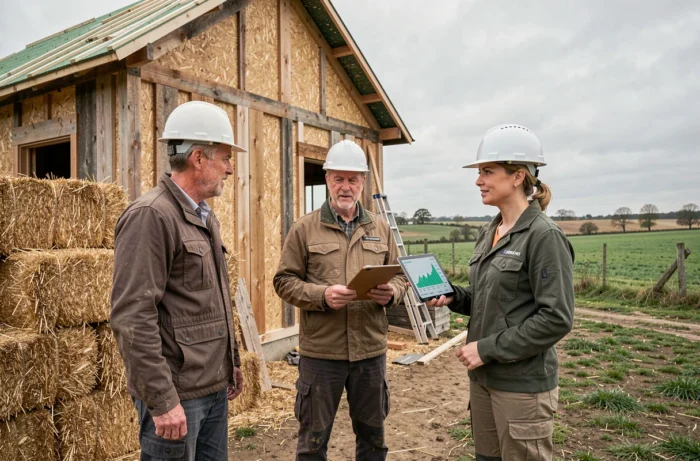
Classic energy renovation (insulation, heating, joinery) only covers part of the ecological housing field. Projects that incorporate bio-based materials (hemp, straw, raw earth, solid wood) or bioclimatic approaches require specific skills that not all RGE artisans possess.
The RGE mention does not guarantee expertise in ecological construction. It certifies a competence in energy efficiency, which is different. An RGE artisan specialized in polyurethane foam insulation does not have the same profile as a builder trained in straw bale insulation.
For a sustainable housing project incorporating natural materials, the contact process differs. It goes through specialized networks in eco-construction, local associations, or thermal study offices familiar with breathable walls and hygroscopic materials. The vocabulary used during the first exchange is a good indicator: a contact person who talks about thermal lag, breathability, or the life cycle of materials likely has an appropriate technical culture.
Verify the consistency between the discourse and the achievements
Requesting references of completed projects remains the most reliable method. A professional in ecological housing should be able to show documented achievements, with feedback on the actual performance of the building after several seasons of occupancy.
The available data do not allow for a conclusion on a single label that would guarantee all skills in eco-construction. Cross-referencing multiple sources of information remains the best protection: RGE directory for regulatory aspects, associative networks for ecological dimensions, and France Rénov’ advisor for the financial framing of the project.
The first contact with an ecological housing expert is best prepared. Arriving with an energy diagnosis, even a rough one, an idea of the desired materials, and a realistic budget allows for a quick assessment of whether the contact person meets the project requirements, rather than multiplying exploratory exchanges without a framework.